
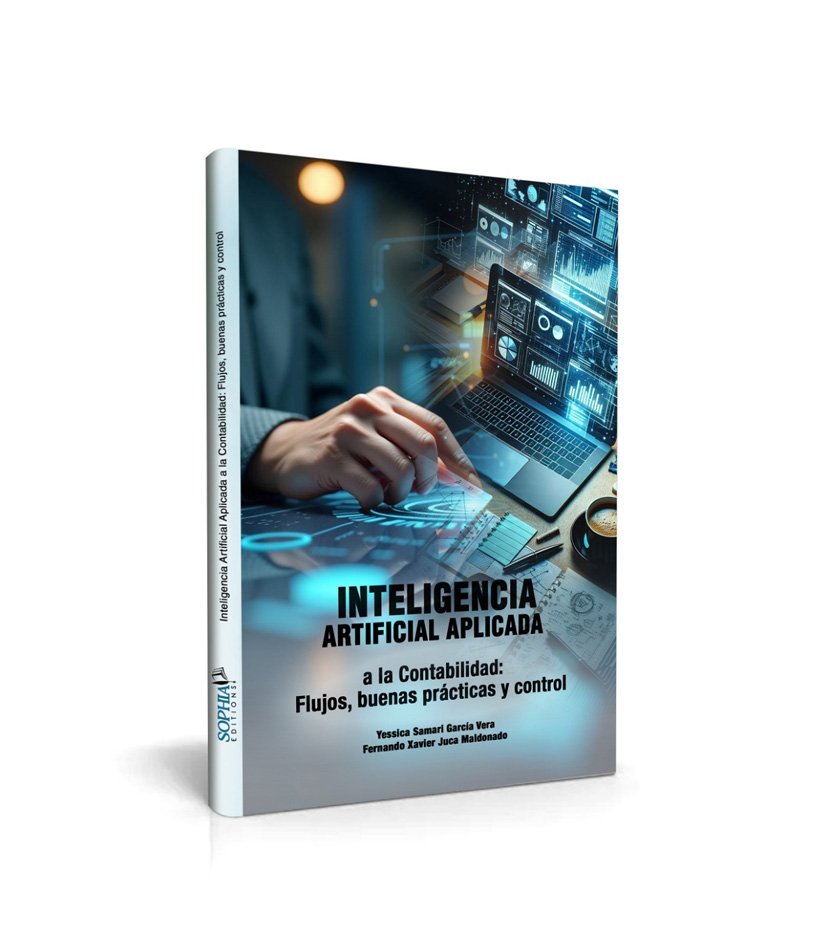
Artificial Intelligence Applied to Accounting: Workflows, Best Practices, and Control
Authors: Yessica Samari García-Vera, Fernando Xavier Juca-Maldonado
ISBN: 978-1-968794-27-9
DOI: https://doi.org/10.64092/CNYF2268
Publication Date: 01/26/2026
Language: Spanish
BISAC Codes: BUS036000; BUS041000; BUS069000
Zenodo: https://zenodo.org/records/18342821
Share it
Description
Artificial intelligence has moved beyond being a promise to become a concrete tool that is transforming accounting, reshaping the ways in which financial data are recorded, controlled, analyzed, and communicated. In this context, a central challenge emerges for accounting students and professionals: integrating artificial intelligence into accounting processes without losing control, professional judgment, or regulatory compliance. This book offers an applied academic approach that guides the reader step by step through the design and governance of automated workflows for essential accounting functions, including transaction recording, classification and coding, bank reconciliation, document management, financial reporting, and the auditing of automatically generated results. Beyond efficiency gains, the work emphasizes the importance of control, traceability, and professional ethics. It explains how to preserve the accountant’s responsibility in automated environments, validate outputs produced by artificial intelligence, and establish governance and version-control systems that ensure transparency and reliability in financial information. Aimed at university students, educators, and accounting professionals, the book combines conceptual foundations with practical examples and best practices, demonstrating that artificial intelligence does not replace the accountant, but rather enhances their capacity for supervision, analysis, and strategic decision-making. The book positions itself as an essential guide for understanding, applying, and leading AI-assisted accounting processes, promoting technological innovation without sacrificing rigor, ethics, or professional responsibility. With this approach, readers will be better equipped to face the challenges of modern accounting and to leverage automation safely, efficiently, and in alignment with current regulations.
Suggested citation (APA, seventh edition)
García-Vera, Y. S., & Juca-Maldonado, F. X. (2026). Artificial intelligence applied to accounting: Workflows, best practices, and control. Sophia Editions.