
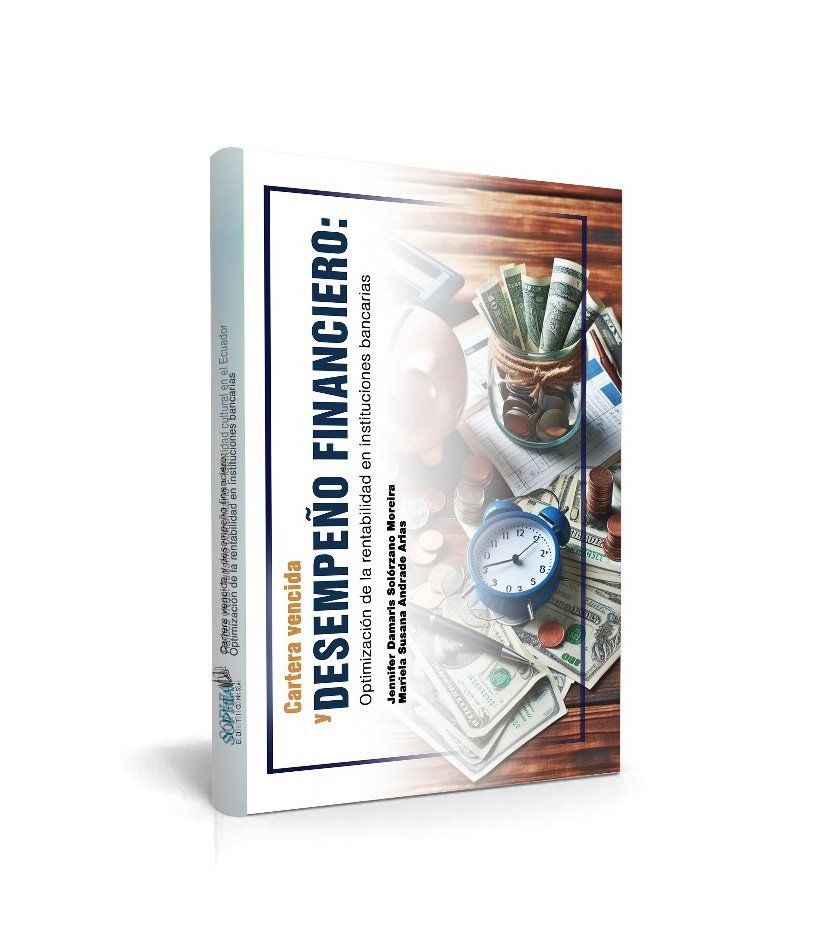
Nonperforming Loans and Financial Performance: Optimizing Profitability in Banking Institutions
Authors: Jennifer Damaris Solórzano-Moreira, Mariela Susana Andrade-Arias
ISBN: 978-1-968794-12-5
DOI: https://doi.org/10.64092/GJBF5706
Year: 2025
Language: Spanish
BISAC Codes: BUS069000; BUS041000; BUS095000
Zenodo: https://zenodo.org/records/17253354
Share it
Description
Managing nonperforming loans constitutes one of the greatest challenges in the Ecuadorian financial system, especially for microfinance institutions, whose social role goes beyond merely granting credit. This book provides a deep and up-to-date analysis of the relationship between delinquency and profitability in Ecuadorian banking, with an emphasis on the experience of the Quevedo Agency of Banco D-Miro in Ecuador during 2023. Through a comprehensive approach, it examines the structural causes behind the increase in delinquency, including the impact of inflation, loss of household income, and over-indebtedness, factors that affect clients’ ability to pay and compromise institutional financial indicators. The study reveals that, although the agency managed to recover 82.99% of overdue loans, weaknesses persist in areas such as the collection rate (65.90%) and refinancing (20.59%), highlighting the need to implement more effective strategies. In this context, the research proposes innovative solutions: portfolio segmentation by risk levels, reducing the average collection period to less than 60 days, technical cleanup of uncollectible loans through predictive models, and incentive schemes for collection staff. These measures aim not only to improve financial indicators but also to strengthen trust between the institution and its clients, reinforcing a culture of shared responsibility within the microfinance system. Beyond the numbers, this book emphasizes that delinquency should be understood as a challenge that drives organizational transformation. Managing nonperforming loans with strategic vision and social sensitivity not only increases profitability but also ensures that microfinance continues to fulfill its essential mission: promoting financial inclusion, supporting entrepreneurship, and contributing to the sustainable development of Ecuadorian communities. This work thus becomes an essential reference for academics, banking executives, and public policy makers.
Suggested citation (APA, seventh edition)
Solórzano-Moreira, J. D., & Andrade-Arias, M. S. (2025). Nonperforming loans and financial performance: Optimizing profitability in banking institutions. Sophia Editions.