
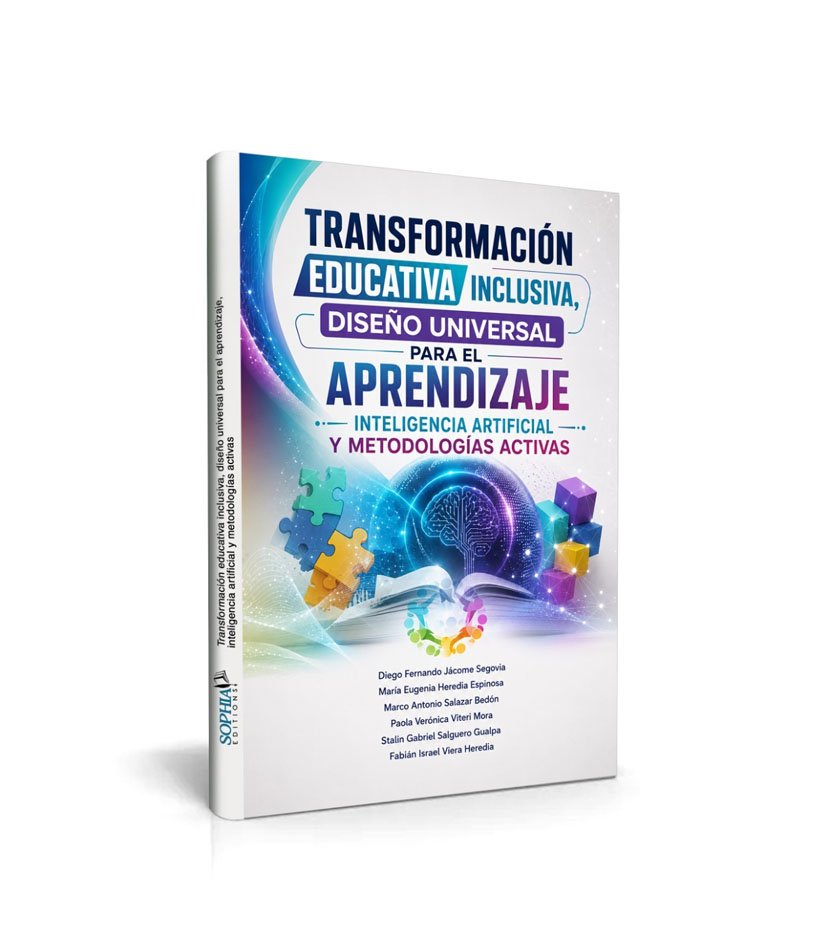
Inclusive Educational Transformation, Universal Design for Learning, Artificial Intelligence, and Active Methodologies
Authors: Diego Fernando Jácome-Segovia, María Eugenia Heredia-Espinosa, Marco Antonio Salazar-Bedón, Paola Verónica Viteri-Mora, Stalin Gabriel Salguero-Gualpa, Fabián Israel Viera-Heredia
ISBN: 978-1-968794-54-5
DOI: https://doi.org/10.64092/LTBW5134
Publication Date: 08/13/2026
Language: Spanish
BISAC Codes: EDU026000, EDU039000, EDU029000
Zenodo: https://zenodo.org/records/21892481
Share it
Description
The educational transformation of the twenty-first century requires moving beyond traditional teaching models to build systems capable of responding to learner diversity through flexible, inclusive approaches supported by technological innovation. This book examines the convergence of inclusive education, Universal Design for Learning, artificial intelligence, and active methodologies as the foundations of a new pedagogical paradigm aimed at ensuring equitable learning opportunities for all students. Drawing on a critical review of major scientific advances and contemporary methodological approaches, the book examines the conceptual foundations of inclusion, the neuroeducational foundations of Universal Design for Learning, and the potential of artificial intelligence to enhance accessibility, personalize learning, and remove educational barriers. It also presents strategies for designing inclusive learning experiences, integrating active methodologies, developing digital competencies, implementing formative assessment, strengthening institutional leadership, and promoting family participation within digital educational ecosystems. The book includes practical guidelines, applied examples, reflective activities, and tools that facilitate the implementation of these approaches across different educational levels, always from an ethical, humanistic, and evidence-based perspective. It argues that genuine innovation does not depend exclusively on the incorporation of intelligent technologies, but rather on the capacity of educators and institutions to redesign their pedagogical practices by placing diversity at the center of every educational decision. The book proposes a comprehensive vision for advancing an educational transformation that combines innovation, equity, and quality, thereby contributing to the development of more accessible, participatory, and socially responsible educational systems.
Suggested citation (APA, seventh edition)
Jácome-Segovia, D. F., Heredia-Espinosa, M. E., Salazar-Bedón, M. A., Viteri-Mora, P. V., Salguero-Gualpa, S. G., & Viera-Heredia, F. I. (2026). Transformación educativa inclusiva, diseño universal para el aprendizaje, inteligencia artificial y metodologías activas. Sophia Editions.